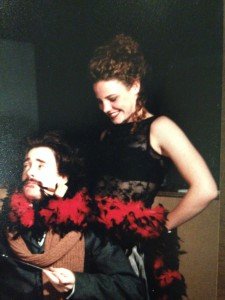
Black silk, lace edges and spaghetti straps. It was short, showed a lot of thigh and clung to my body. But I was only twenty, I hadn’t given birth yet, I hadn’t breast fed two children, so I was okay with that.
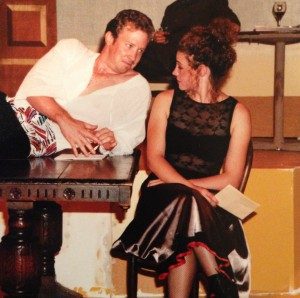
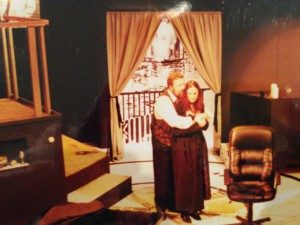
I was rehearsing for a community theatre performance of Death of a Salesman. I was playing the part of ‘the woman’, opposite a much older Willy Loman. The part of his wife was played by his real-life partner, so our on-stage betrayal felt double-fold. I was in my nightie, Willy was supposed to be telling me to leave the room following one of our secret trysts; my character was meant to be attempting to seduce him. That’s why it blind-sided me so much when he twitched the strap from my shoulder. The top of my nightie dropped as the strap slithered down my arm.
I’m not sure how much of my breast was revealed to the rest of the cast in that small upstairs room above an old theatre in Chatswood. I wasn’t wearing a bra. I remember that my hand flew up to cover myself as I yanked the nightie up. I glared at him, torn between embarrassment and fury. Had his actions been in character, it probably wouldn’t have bothered me. No, what upset me was that it seemed like a personal impulse.
Afterwards, the director spoke with me. “I think we need to find you a different nightgown for this scene.” I took my black, silk nightie home and folded it away in my pyjama drawer. ‘The Woman’ in Death of a Salesman has no lines; the only sound she makes on stage is to laugh. Many years later I wrote a piece for a creative writing class in which I gave this nameless woman a voice. “Am I more? Am I more than just a body? More than simply laughter? I have a name, Willy Loman! I am more than just a woman. I have a name,” I scrawled passionately across the page.
The woman wasn’t the part that I originally auditioned for in Death of a Salesman. I wanted to play the part of Miss Forsythe. I worked hard on a strong Boston accent. But the director told me she had another part in mind for me and I accepted, grateful to be cast.
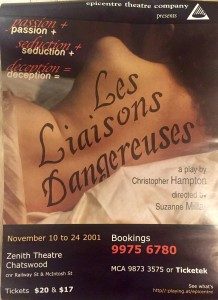
It wasn’t the first time I’d played the part of someone promiscuous on stage. Under the same director I’d played the part of a courtesan in Les Liaisons Dangereuses. During rehearsals, the director asked me if I’d feel comfortable being photographed semi-naked for the show’s posters. My topless back and hips appeared on the programs, the flyers and a five-foot light box out the front of the theatre. I had a strange relationship with that photo. I thought that my shoulder jutted out at a strange angle. I thought that the stretch marks of puberty on my hips were too prominent. And yet, somehow I loved it. I loved my bold and naked curves.
I don’t think that these roles were what I had planned when I first set out to become an actress. I was twelve or thirteen when my parents first took me to the theatre. I remember being in the crowded, narrow foyer during intermission. People squeezed past one another carrying hot tea and coffee in styrofoam cups along with scotch finger biscuits. I don’t remember which play it was that we watched, but I do remember desperately wanting to be a part of that on-stage world.
I was seventeen when I auditioned for my first play, Picasso at the Lapin Agile for Castle Hill Theatre. The character description on the audition notice was as follows: ‘Suzanne, 18-25 year old female – sexy, street-smart.’ I phoned the number on the notice and earnestly asked if a 17 year old would be close enough. They assured me that was fine. I wanted that part so badly. I got hold of the script and practised so much that I had learnt all of Suzanne’s lines by heart before even having auditioned.
On stage, I showed off my knowledge by dropping my script to the floor. Two lines later, I missed a cue and another actor had to signal to me that it was my line. Later, that actor suggested to me that regardless of how well I thought I knew the lines, it was never a good idea to discard my script during an audition. I’m sure he stopped short from adding, “…Because it makes you look like a prat.” My confidence paid off though. I got the part.
Theatre life immediately grabbed hold of me. Picasso had a cast of eleven people, an eclectic mix of young and old. The other actors would sneak me into pubs for post-rehearsal drinks. On performance nights we’d stay late after each show, drinking in the theatre: wine, spirits, shots. A dinner-roster was drawn up, with two cast members responsible each performance for bringing dinner for everyone else. It felt so cosy and intimate – all of us sharing casserole and rice together late at night. We ate off our laps, perched on stools, or squished together on couches in the green room after a show. That cast had become my theatre family.
But the role of Suzanne was more confronting than I had first realised. In the opening scene, I had to change my top on stage. ‘Turn away from the rest of the cast’, the director told me, ‘like you’re being shy’ – but this meant facing out towards the audience. Perhaps it was this role that foreground my run of sexually mature characters on stage, ironic considering I was barely mature myself.
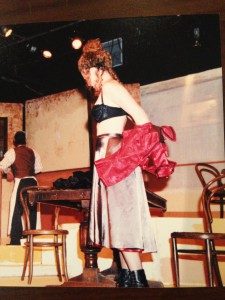
During Picasso I met Dave, another actor. He was older than me, in his early twenties, quick-witted and attractive. He flirted with me, a crush was inevitable. On closing night we shared one drunken kiss pushed up against the yellow Formica counter in the small kitchen nestled between the stage and the foyer. My love for the theatre was changing – rather than being propelled by the comfort of close-knit, family-like relationships, it was being fuelled by sexual desire. There was something about the adrenalin boost of being on stage, the power of being semi-naked in front of a hundred people, coupled with the late nights and the alcohol – it made me feel alive, it turned me on.
When the run of Picasso came to an end, I remember feeling at a loss. These people who I had worked so closely with for several months were suddenly out of my life. I missed the camaraderie. I missed the in-jokes. I missed the kissing, the drinking.
In almost every play I was involved in after Picasso, I would find myself falling for another actor. In Our Country’s Good, I split up with my boyfriend for my on-stage love interest – on closing night, we snuck away from the cast party and slept together under the stars. Admittedly, it didn’t work out, when the show wrapped up, so did the romance. But the fact is, an on-stage spark led to a very real off-stage encounter, and it was a cycle that would often repeat itself for me.
I went on to perform at Hunters Hill Theatre, The Zenith in Chatswood and Bondi Pavilion. More kissing, more on-stage relationships, more sexually charged roles. Until it all came to an end. An argument with a director over a missed rehearsal due to work commitments lead to a falling out with a few key people in the theatre community – theatre politics can be tricky. The stage began to lose some its sheen of magic for me. Besides, by then I had met my husband, which meant acting no longer led to late night kisses or romantic trysts with other cast members – I was in love. Then I had children, started a degree, became a writer and there was no time for the theatre. After that, I simply forgot about my dream of being an actress.
My theatre days are over ten years ago now. Tonight, I’m driving into the local theatre to watch a rehearsal of the Castle Hill Players’ upcoming production. I wanted the chance to immerse myself in theatre life one more time before writing this article. It’s been too long; I need to reminisce before I can write.
When I arrive, the first thing that strikes me is the familiarity of being at the theatre on a cold winter’s night. I can recall the anticipation I once felt at being part of a production. I notice the distinct smell of the theatre, particularly in the green room. It’s musty but in a nice way.
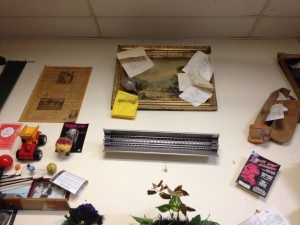
Memorabilia from past productions covers the green room walls and ceiling. Sticky-taped programmes strung up with mismatched old props: a wine glass, a decorative wooden fan, a red silk dress, a faded photo behind broken glass. I spot props from my own past productions and feel satisfied that my memories are still preserved here on this wall.
The actors all seem at home, comfortable – like I once was. They are nonplussed by my presence – no one even questions who I am. I begin to feel awkward as I wait for someone to ask me why I’m there. Thankfully the director, Bernard appears and introduces himself. He’s hard to read. He’s nice enough, but I feel like he’s keen for me to take a seat and stay out of the way. The more I look at Bernard, the more I find him familiar and I wonder if he might be the same director I once auditioned for at Chatswood. I completely blew that audition because it involved singing – and I can’t sing.
Once I’m seated in the theatre, I’m momentarily left on my own. I feel suddenly disappointed that I can’t be more of a part of it all. I feel like I want them to know who I am. That I used to be a part of this world too. The actors start warming up on stage. Someone is tap dancing for fun; someone else is making kookaburra sounds.
The theatre becomes colder as it gets later. I’m watching a relationship blossom on stage between two characters and I begin to wonder if they’re also connected off stage. Their on-stage kiss is so sweet and intense – and yet awkward because they keep getting interrupted by another actor cutting in with her next line too early, so they keep pulling apart and laughing. Their intimacy is so real that I almost feel voyeuristic watching them.
During Picasso, I experienced my first ever stage-kiss. No one gave me any sort of direction, and I kissed the actor opposite me in the same way that I would kiss any cute boy in real life. I didn’t know you weren’t supposed to use your tongue.
In the foyer after opening night, I met his partner. Her name just happened to be Suzanne – the same as my character. The first thing she said to me was, “Hi Nicola, I’m the real Suzanne.” I froze, felt my face flush red. But then she laughed and I stopped panicking that she wanted to scratch my eyes out; she was friendly and kind and complimentary of my acting. Strangely enough though, that was only the beginning of my relationship with Suzanne; it turned out she was a director, the same director who later cast me in both Les Liaisons Dangereuses and Death of a Salesman. The same director I subsequently had that falling out with. I guess it’s sort of poignant that she should be there at both the start and the end of my short-lived theatre career.
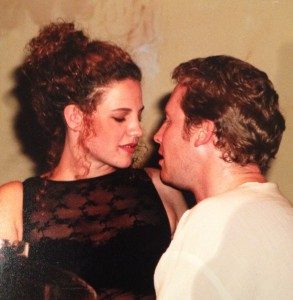
As tonight’s rehearsal comes to an end, I approach the on-stage couple and ask them about their relationship, “Are you two… together, off stage?” They laugh and reassure me that they’re not. In fact, they both have partners. I’m surprised – I think there’s a real chemistry between them, it’s palpable even when they’re interacting off stage. But then, perhaps I’m projecting my own memories onto them. Just because I always fell for my on-stage partner doesn’t mean it should happen with them. I ask if I can have a photo of the two of them together and as they step towards one another I snap a shot before they’ve posed. When I look back at the photo, I’m once again convinced a spark exists.
Before I leave the theatre, I thank Bernard for letting me come along and mention how much watching tonight’s rehearsal has made me miss my time in the theatre. He responds, “When you come here you can shake off everything else from the day – doesn’t matter if you’ve had a crap day at work, you’re in a different world here, it’s an escape.”
His words affect me and I find myself feeling momentarily deflated as I leave the theatre. Did I make a mistake, all those years ago by giving up on my dream of being an actress? As I drive home though, all I can think about it writing this article and I’m reassured, writing is my life now.
Perhaps acting was never really my dream after all.